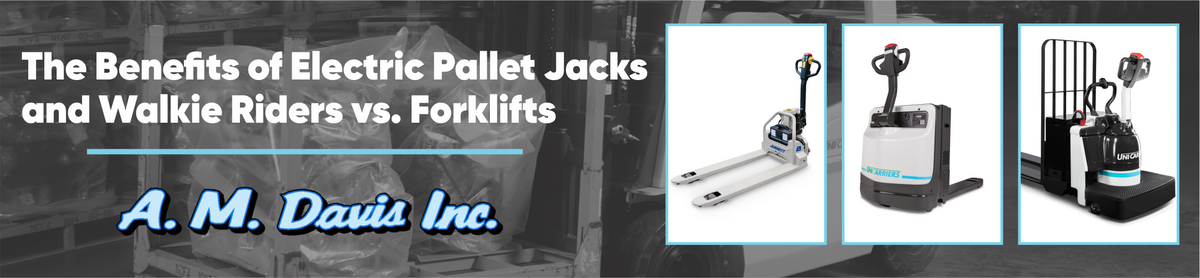
Sit-down rider forklift certainly do the mainstay of the lifting in most material handling and storage operations. But there are many times when an electric pallet jack or an electric walkie-rider can do the same job, at significantly reduced costs. Below are some the situations you may want to consider and electric pallet jack in lieu of a traditional sit-down forklift:
An electric pallet jack can be a better choice than a forklift in several situations, especially when the task doesn’t require the lifting height or heavy-duty capacity of a forklift. Here are some common scenarios:
Loading and unloading trucks – Pallet jacks are compact and easy to maneuver in tight trailer spaces where a forklift may not fit.
Short-distance transport – Moving pallets across a warehouse floor, staging area, or production line is often faster and more efficient with a pallet jack.
Tight aisles or crowded spaces – Their smaller size makes them ideal for operations with narrow aisles or dense storage layouts.
Lighter loads – For standard pallets under about 4,500–6,000 lbs (depending on model), pallet jacks are sufficient and more economical.
Lower cost and maintenance needs – If lifting to racking heights isn’t necessary, using a pallet jack avoids the higher operating costs of a forklift.
Delivery applications – Many delivery trucks carry electric pallet jacks to move product from the truck into customer locations where forklifts aren’t available.
In short, if the job is ground-level, lower weight, and in tight or mobile settings, an electric pallet jack is usually the more practical choice.
And a nice compromise between an electric pallet jack and sit-down rider is an electric walkie rider, which gives the operator a choice between walking behind the unit, or riding on a small platform. Below are some of the conditions that might warrant a walkie-rider over a traditional electric forklift:
both electric walkie pallet jacks (traditional) and electric rider pallet jacks are designed for moving loads at ground level, but each has strengths depending on the application. Here’s when a rider pallet jack would be preferred:
When to Choose an Electric Rider Pallet Jack
Longer travel distances – Rider jacks allow operators to stand or ride on the unit, reducing fatigue compared to walking behind for extended runs across large warehouses or distribution centers.
High-throughput operations – They’re faster than walkies, making them ideal in environments with heavy pallet movement and frequent trips.
Cross-docking and staging – Perfect for quickly shuttling pallets between docks, staging areas, or production lines.
Operator comfort & productivity – Standing platforms and ergonomic controls improve operator comfort on long shifts, which boosts efficiency.
Larger facilities with wide aisles – Their speed and ride-on design are most beneficial where space allows for safe maneuvering.
When a Walkie Pallet Jack is Better
Short hauls or tight spaces – Walkies are more compact, easier to turn in narrow aisles, and better for confined spaces like inside trucks.
Occasional or light-duty use – Walkies are more economical for operations that don’t need constant pallet movement.
In short:
Rider pallet jacks = speed, long distances, and productivity.
Walkie pallet jacks = tight spaces, short distances, and lower cost.
Here's a chart to help you see the differences side-by-side:
Electric Walkie vs. Electric Rider Pallet Jack
Feature / Use Case
Electric Walkie Pallet Jack
Electric Rider Pallet Jack
Operator Position
Walks behind unit
Rides/stands on platform
Best for
Short distances, tight spaces
Long distances, high-volume moves
Speed
Slower
Faster, more efficient over distance
Maneuverability
Excellent in confined areas (trailers, narrow aisles)
Requires wider aisles, less agile
Fatigue
Higher on long shifts or distances
Lower – operator rides instead of walks
Typical Applications
Loading/unloading trucks, short hauls, small warehouses
Cross-docking, staging, large DCs, production lines
Cost
Lower purchase price & operating costs
Higher cost, but more productive in large facilities
Facility Size Fit
Small to mid-sized facilities
Large warehouses or distribution centers
Quick takeaway:
Choose a walkie if your work is mostly short-haul, tight-space, or cost-conscious.
Choose a rider if your facility requires long-distance travel, speed, and operator comfort.
Now lets take a quick look at the benefits of choosing an electric pallet jack or electric walk-rider over a traditional sit-down forklift. The obvious initial benefit is the purchase price. You can purchase several electric pallet jacks or walkie-riders for the initial purchase price of man sit-down rider models. But the benefits extend beyond that to include:
Benefits of Electric Pallet Jacks vs. Sit-Down Rider Forklifts
Lower cost – Purchase price, maintenance, and operating expenses are generally much lower.
Compact size – Easier to maneuver in tight spaces like trailers, small warehouses, or congested aisles where forklifts may struggle.
Ground-level efficiency – Ideal for moving pallets across floors without needing lift height.
Ease of use – Simple controls and less operator training required compared to forklifts.
Lower risk of damage – Less likely to cause racking or product damage since they only lift to a few inches off the ground.
Reduced fatigue – Electric power reduces strain compared to manual pallet jacks, while still being lighter and easier to handle than forklifts.
Flexibility in delivery – Commonly used on delivery trucks for final-mile pallet movement where forklifts aren’t practical.
Safety – Operates at lower speeds than forklifts, lowering the risk of severe accidents in high-traffic areas.
In short: Electric pallet jacks are the better option for cost savings, tight spaces, ground-level moves, and delivery applications, while sit-down forklifts are needed for heavier loads and high stacking.
Benefits of an Electric Walkie-Rider Pallet Jack vs. a Sit-Down Rider Forklift
Faster ground-level transport – Walkie-riders are designed for quickly moving pallets across long distances, making them more efficient than forklifts for horizontal travel.
Lower operating costs – Purchase price, maintenance, and energy costs are typically lower than a sit-down forklift.
Higher productivity in staging and cross-docking – Ideal for dock-to-dock pallet movement, order staging, and high-throughput operations where lift height isn’t required.
Operator convenience & reduced fatigue – With a ride-on platform, operators save energy compared to walking, while still avoiding the full climb in/out motion of a sit-down forklift.
Maneuverability in tighter areas – More compact than forklifts, making them easier to handle in congested aisles or loading docks.
Lower damage risk – Because they lift only a few inches off the ground, there’s less chance of damaging racks, overhead structures, or stacked loads.
Safety advantages – Slower operating speeds and a lower center of gravity reduce the severity of potential accidents compared to sit-down forklifts.
Final-mile flexibility – Common in large distribution centers and delivery operations where pallets need to be moved quickly without high stacking.
In short:
Walkie-riders excel at high-speed, ground-level pallet movement in large warehouses or docks.
Sit-down forklifts are better when you need heavy lifting, stacking, or high reach.
The great news is, our team of material handling specialist can help you select the right combination of equipment to maximize your through-put and minimize the costs of your handling and storage operations. We stock many models of electric pallet jacks, walkie-riders and sit-down models so we are able to help you configure the right combination of equipment for each facet of your operations. See our line-up of UniCarriers electric pallet jacks and walkie-riders, and give us a call in Richmond Metro at 804-233-0051 for a consultation.
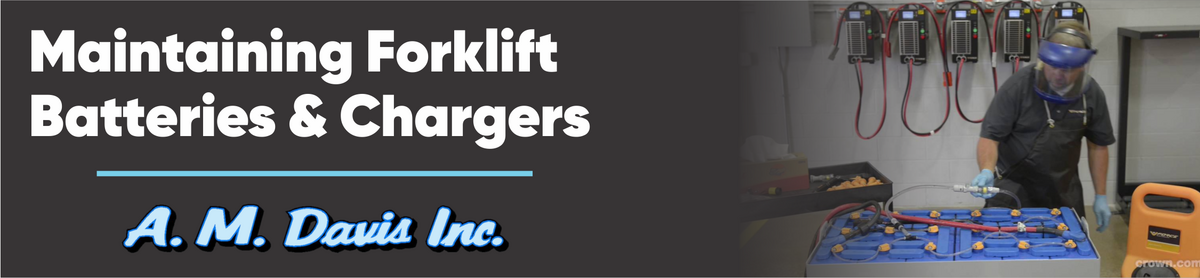
As more of our industry migrates towards electric forklifts, it is important to maintain your forklift batteries and chargers. Properly maintained forklift batteries and chargers will:
Perform better on a daily basis by holding charges longer and maximizing output
Last longer! By maintaining your batteries and chargers to manufacturer's recommendations, you ensure the longest life possible
Be safer to work around. Poorly maintained batteries and chargers can present a danger to those working near or on them
This month we provide some tips to help you get the most out of your forklift's batteries and chargers.
Battery Maintenance Tips
Charge Properly
Only charge when the battery is between 20–30% capacity (don’t top off during shifts).
Always allow a full charge cycle—avoid interrupting mid-charge unless absolutely necessary.
Maintain Proper Water Levels
Check electrolyte levelsweekly, and top off with distilled waterafter charging if needed.
Never overfill; it can cause overflow during charging.
Keep Batteries Clean
Regularly clean the battery case and terminals with a damp cloth or baking soda solution (neutralizes acid residue).
Corrosion or dirt buildup can lead to energy loss or safety hazards.
Equalize Charges
Perform an equalization charge (a longer charge to balance cell voltage) weekly or per manufacturer’s recommendation to prevent sulfation and extend life.
Inspect for Damage
Look for cracks, bulges, corrosion, or leaks.
Tag and remove damaged batteries from service immediately.
Monitor Temperature
Keep batteries in a cool, dry place. Overheating during charging can reduce battery lifespan.
Avoid exposing batteries to extreme temperatures (ideal range: 60–80°F).
Charger Maintenance Tips
Use the Correct Charger
Always use the manufacturer-recommended charger for the specific battery type and voltage.
Inspect Cables & Connectors
Check for frayed wires, loose connections, or melted plugs regularly.
Damaged connectors can cause poor charging or fire hazards.
Keep Chargers Clean & Ventilated
Ensure chargers are free of dust and debris and have proper airflow to avoid overheating.
Don’t “Opportunity Charge”
Charging during short breaks or lunch can shorten battery life unless the battery is designed for it (like lithium-ion models).
Log Charging Activity
Keep a charging log or use battery management software to track usage and detect early signs of trouble
Bonus Tip:
Training operators and technicians on proper battery handling and safety procedures is key to avoiding damage and extending battery and charger life.
Maintaining forklift tires properly can extend their life, improve safety, and enhance operator comfort. Here are some practical tips for keeping your forklift tires in good condition:
Perform Regular Inspections
Check for wear and damage: Look for cracks, chunking, flat spots, or excessive wear. Make tire inspections part of your normal forklift pre-shift inspection, as required by OSHA. Download our Forklift Inspection Forms HERE.
Inspect tread depth: On pneumatic tires, ensure there’s enough tread for traction and cushioning.
Look for signs of separation or embedded debris.
Maintain Proper Tire Pressure (Pneumatic Tires)
Check inflation daily: Under- or over-inflated tires can cause uneven wear and reduce stability.
Use manufacturer-recommended pressure settings.
Rotate Tires
Even out wear patterns by rotating tires regularly (especially on multi-wheel forklifts).
Avoid Overloading
Stick to the forklift’s rated capacity. Excess weight increases tire wear and risk of failure.
Drive Smart
Avoid sharp turns, quick starts/stops, and high speeds.
Reduce impact with curbs, potholes, or dock edges to prevent tire damage.
Maintain Clean Work Areas
Debris, sharp objects, and uneven surfaces can puncture or wear tires prematurely.
Sweep aisles regularly and repair uneven flooring.
Replace Worn Tires Promptly
Cushion tires: Replace when wear line is reached or when the tire diameter is 2 inches less than original.
Pneumatic tires: Replace when tread is worn down or casing is damaged.
Use the Right Tire for the Application
Cushion vs. pneumatic: Make sure your forklift has the correct tire type for your environment (indoor vs. outdoor).
Consider solid pneumatics for heavy-duty or debris-laden areas to avoid flats.
Selecting the proper tires for your forklift and maintaining them is key to creating a safe working environment for your employees, and keeping your costs down by getting the most out of each set of tires you purchase. For more information about forklift tire replacement visit our Forklift Tire Replacement page, or contact us at 804-233-0051 for information and pricing. We replace tires for ALL MAKES and MODELS.